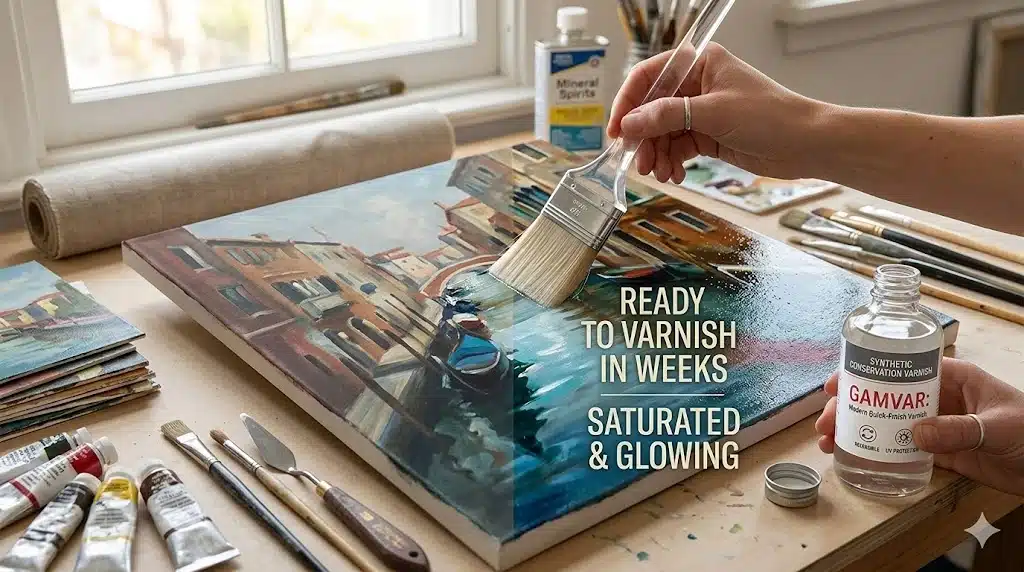
1. Modern Varnishing: The Quick‑Finish Technique for Oils
For decades, oil painters have heard the same advice: wait six months to a year before you varnish. That rule came from an era of natural resins and strong solvents, when putting a varnish on too early could soften the paint film and fuse the varnish into it permanently.
The problem is obvious if you work professionally or exhibit regularly: very few painters can afford to warehouse finished but unvarnished work for half a year. That’s where modern varnishing systems come in. Thanks to synthetic resins and milder solvents, you can now safely apply a full, removable final varnish much earlier—sometimes in a matter of weeks—without breaking conservation rules.
This is what we mean by “quick‑finish varnishing” for oils: a way to complete, protect, and present an oil painting in a realistic timeframe, while preserving the ability to remove and replace that varnish decades later.
1.1. Why the Old 6–12 Month Rule Existed
To understand why modern varnishes are different, it helps to know what the old rule was protecting you from.
1.1.1. Traditional varnishes and strong solvents
Historically, picture varnishes were natural resins such as dammar or mastic dissolved in strong solvents like turpentine. These systems have two major issues if applied too soon:
- The solvent can partially dissolve or swell an oil paint film that is still curing.
- The resin can penetrate and crosslink with the uppermost paint layers, making the varnish no longer a distinct, removable film.
1.1.2. The role of oxygen and curing
Oil paint dries by oxidation and polymerization of the drying oils, not by simple evaporation. Even after a surface feels dry, crosslinking continues deeper within the film for months. Traditional varnishes formed relatively impermeable layers, so conservators rightly urged patience to avoid damaging a soft paint surface.
1.2. What Changed: Synthetic Resins and Mild Solvents
Modern “quick‑finish” varnishes are built on synthetic resins designed to be soluble in mild solvents such as Odorless Mineral Spirits. They remain a separate, removable layer and are permeable enough that drying oils can continue to cure underneath.
1.2.1. Why these varnishes can go on earlier
- Gentler solvent: Odorless Mineral Spirits is not strong enough to dissolve a properly dried oil film.
- Non‑crosslinking resin: The resin is engineered to sit on top of the paint, not chemically bond into it.
- Permeability to oxygen: These varnishes allow oxygen to reach the paint film, permitting ongoing curing.
1.3. How Soon Can You Varnish with Modern Systems?
Exact timing depends on thickness and environment, but typical manufacturer guidance is:
- Thinly painted oils: Often ready in about 2–3 weeks after completion.
- Moderate texture: Generally in the 1–2 month range.
- Very thick impasto: May still benefit from longer waits (6+ months).
Rule of thumb: Test the thickest area by gently pressing a fingernail into it. If the surface is firm and does not dent, it is typically safe for a mild‑solvent varnish.
1.4. Quick-Finish vs. Retouch Varnish
Retouch varnish is a thin, permeable layer intended for use on fresh paintings to restore saturation temporarily. Modern quick‑finish synthetic varnishes are different because they are meant as a full, conservation‑grade picture varnish that can be applied much sooner than traditional rules allow.
1.5. Benefits for Working Artists
- Faster turnaround: Deliver finished, protected work to clients or galleries in weeks.
- Better presentation sooner: Fix uneven gloss and sunken areas before exhibition.
- Conservation‑friendly: Remains removable with mild solvents even years later.
1.6. Integrating Quick-Finish Varnishing into Your Workflow
1.6.1. Paint with drying in mind
Use fast‑drying mediums (e.g., alkyds) and avoid extremely thick single‑pass impasto if you want a fast turnaround.
1.6.2. Test for dryness
Perform touch and pressure tests on the thickest, darkest passages before applying any varnish.
1.7. Step‑by‑Step Guide
- Light surface cleaning: Gently dust the surface with a soft brush or microfiber cloth.
- Decant varnish: Pour a small amount into a clean container; most are used as is.
- Apply a thin, even coat: Lay the painting flat. Apply in long, overlapping strokes in one direction. Avoid over-brushing.
- Let it dry: Leave undisturbed in a dust‑free area for 24 hours.
- Optional second coat: Two thin coats are always better than one thick one.
1.8. Quick Reference: Modern Varnishing Comparison
| Feature | Traditional Varnish | Modern Quick-Finish |
|---|
| Wait Time | 6–12 Months | 2–8 Weeks |
| Solvent Type | Strong (Turpentine) | Mild (Odorless Mineral Spirits) |
| Removability | Harder over time | Easy with mild solvent |
| Oxygen Permeable | No | Yes |
For working artists, this is not just a convenience; it’s a practical way to align studio practice with exhibition schedules and conservation standards at the same time.